朝花夕拾 - Make Sense of a Senseless World
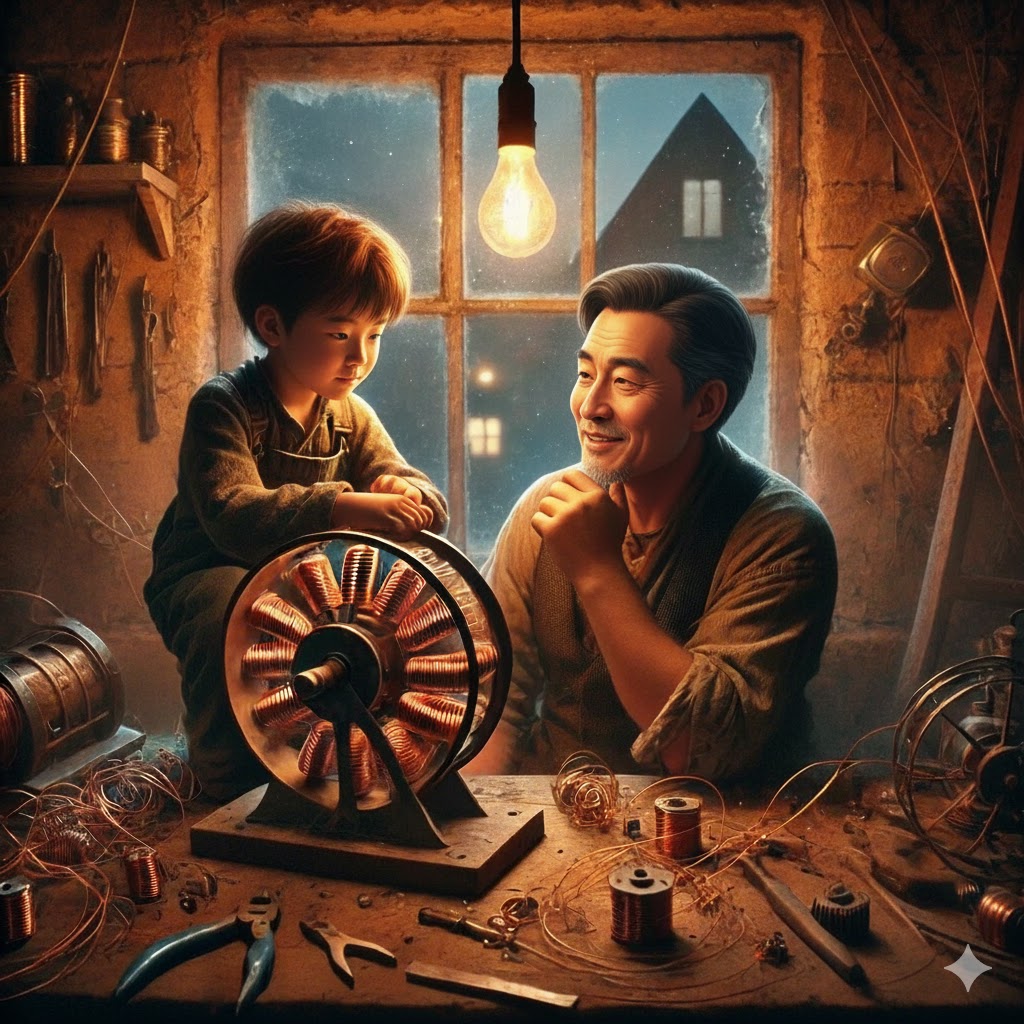
My fondest childhood memory is talking about physics with my father. He was self-taught and never received a formal education. To make a living, he drifted through a series of odd jobs—carpenter, chemist, accountant. Along the way, he taught me how to build electric motors and transformers. I was captivated by how these machines worked, by the hidden order beneath their moving parts.
In high school, I took several physics classes and dreamed of becoming a theoretical physicist. In college, however, I came to realize that I was terrible at mathematics and unlikely to make a career in physics. I turned instead to biology and computer science, and eventually became a software engineer at a small search company.
During the COVID-19 lockdown, life suddenly felt fragile, as if any moment might be our last. We are all given roughly the same amount of time in this world; what matters is how consciously we choose to spend it. A busy life is a wasted life. I chose to leave my corporate job and return to the simple question that had intrigued me since childhood: How does the universe operate?
朝花夕拾 may be translated as “Dawn Blossoms Plucked at Dusk”. I am grateful that I still have time to gather the scattered flowers of my childhood dreams, to hold them once more before everything turns to dust.
We must learn from those we will never meet. I like to imagine the conversations they might be having now.
Richard P. Feynman So what happened to the old theory that I fell in love with as a youth? Well, I would say it’s become an old lady, that has very little attractive left in her and the young today will not have their hearts pound anymore when they look at her. But, we can say the best we can for any old woman, that she has been a very good mother and she has given birth to some very good children.
\[\begin{align*} \psi&= e^{i 2\pi \cdot z} \\ z&= \frac{S}{h} = \frac{t}{\tau} = \frac{x}{\lambda} \\ h&= E \tau \le \Delta E \Delta t \\ h&= p \lambda \le \Delta p \Delta x \\ c&=\frac{\lambda}{\tau} =\lambda f \\ m&=\frac{E}{c^2}=\frac{h\tau}{\lambda^2} \\ \vec{f}&= \frac{\vec{p}}{\tau} = \frac{E}{\vec{\lambda}} = \frac{h}{ \tau \vec{\lambda}} \end{align*}\] \[\begin{align*} \psi(\mathbf{x}_{out}, t) = \sum_{p \in \mathcal{Paths}} c_p \psi(\mathbf{x}_{in}, t_0) \\ \rho(x,t)= \frac{1}{i2\pi} \bar{\psi}(x,t) \dot{\psi}(x,t) \\ P(x, t) = \int_{t-\frac{\Delta t}{2}}^{t+\frac{\Delta t}{2}} \int_{x-\frac{\Delta x}{2}}^{x+\frac{\Delta x}{2}} \rho(x',t') \mathrm{d} x' \mathrm{d} t' \end{align*}\]Richard P. Feynman: One might still like to ask: “How does it work? What is the machinery behind the law?” No one has found any machinery behind the law. No one can “explain” any more than we have just “explained.” No one will give you any deeper representation of the situation. We have no ideas about a more basic mechanism from which these results can be deduced.
Albert Einstein: But, if you can’t explain it simply, you don’t understand it well enough.
Richard P. Feynman: I think I can safely say that nobody understands quantum mechanics.
John Archibald Wheeler: Behind it all is surely an idea so simple, so beautiful, that when we grasp it - in a decade, a century, or a millennium - we will all say to each other, how could it have been otherwise? How could we have been so stupid?
Galileo Galilei All truths are easy to understand once they are discovered; the point is to discover them.
Max Born I have tried to read philosophers of all ages and have found many illuminating ideas but no steady progress toward deeper knowledge and understanding. Science, however, gives me the feeling of steady progress: I am convinced that theoretical physics is actual philosophy.
Galileo Galilei Mathematics is the language in which God has written the universe.
Charles Darwin I have deeply regretted that I did not proceed far enough at least to understand something of the great leading principles of mathematics, for men thus endowed seem to have an extra sense.
Ludwig Boltzmann If you ask me about my innermost conviction whether our century will be called the century of iron or the century of steam or electricity, I answer without hesitation: it will be called the century of the mechanical view of nature, the century of Darwin.
Albert Einstein: The important thing is not to stop questioning. Curiosity has its own reason for existence. One cannot help but be in awe when he contemplates the mysteries of eternity, of life, of the marvelous structure of reality. It is enough if one tries merely to comprehend a little of this mystery each day.
Men rise and fall like winter wheat, but the ideas they left behind will never die.